A detailed understanding of material flows is needed to target increased material efficiency and circular economy. In this article, the U.S. steel flow is modeled as a series of nodes representing processes and products. An easily updatable nonlinear least squares optimization is used to reconcile the inconsistencies across 293 collated data records on flows through and between the nodes. The data come from an integrated analysis that includes top-down estimates of steel flow from trade bodies and government statistical agencies, bottom-up estimates of the steel embedded in products based on production statistics and bills of materials, and the mass of imports and exports based on international money flow. A weighting methodology is used to consistently assign confidence scores to the data, and the optimization is used to achieve mass balance and minimize the sum of the squares of the weighted residuals. The results indicate that yield improvement efforts should focus on sheet metal forming in the car industry, which accounts for nearly half of all generated fabrication scrap. The quantity of end-of-life scrap exported and land-filled is greater than the quantity of steel products imported. Increased domestic recycling of end-of-life scrap might displace around a third of these imports.

Achieving a U.S. circular economy would reduce environmental impacts and increase material independence. This article calculates maximum recycled contents (RCs) and recycling rates (RRs) in an independent U.S. steel sector, and estimates the potential to displace current imports with recycled scrap that is currently destined for landfill, hibernating stocks, or export (LHSE). A U.S. dynamic material flow analysis (1880–2100) is conducted to estimate annual steel consumption and scrap generation. The results are coupled with a linear optimization model that minimizes primary steel demand while satisfying the volumetric and compositional demands of new consumption. The compositional analysis examines only copper content because it is of greatest concern to recyclers.
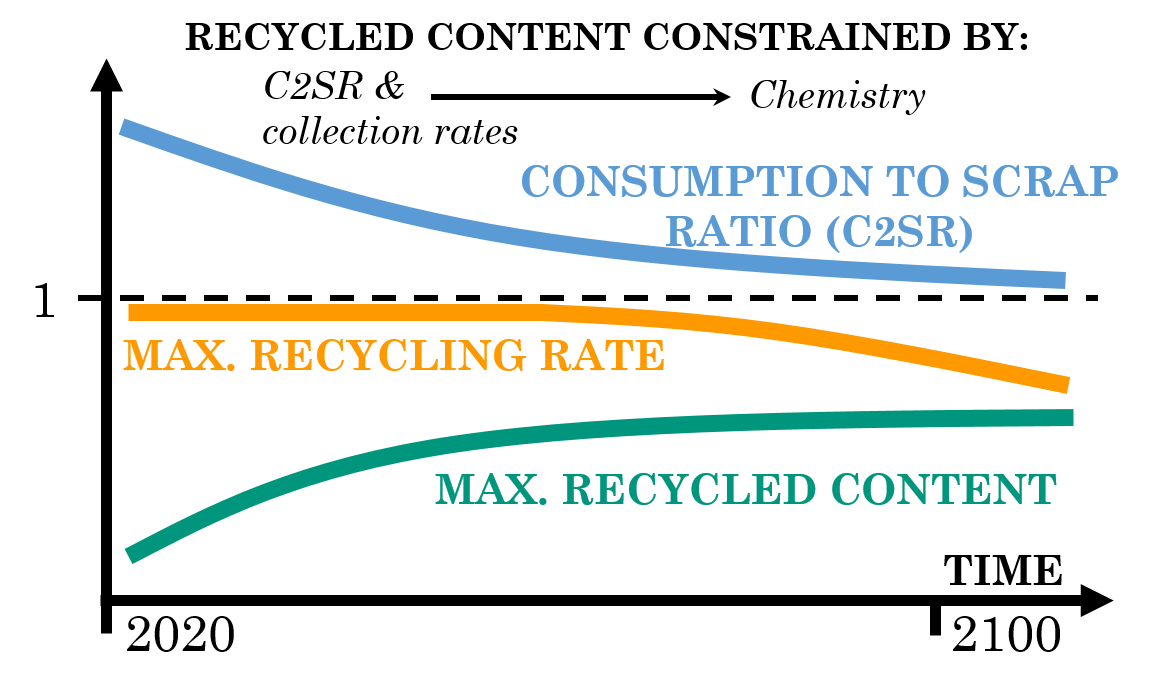
The best estimate is that the maximum independent RR is already constrained by copper contamination. Without interventions, this maximum RR will gradually decline throughout the century. The annual consumption to scrap availability ratio (C2SR) will decrease from around 1.4 today. Concurrently, the maximum RC rises but then plateaus below 75% as the RR falls. This highlights a conflict in the conditions for a circular economy: a C2SR approaching unity is a necessary condition for a high RC but leads to fewer opportunities for scrap contaminant dilution, which decreases the RR. Improved product design for recycling and deployment of scrap refining technologies will be needed to reach higher RCs. In 2017, the mass of U.S. scrap destined for LHSE exceeded direct steel imports. Domestic recycling of scrap exports alone could have displaced 36% of direct steel imports, reducing the U.S. deficit by $5.5 billion.


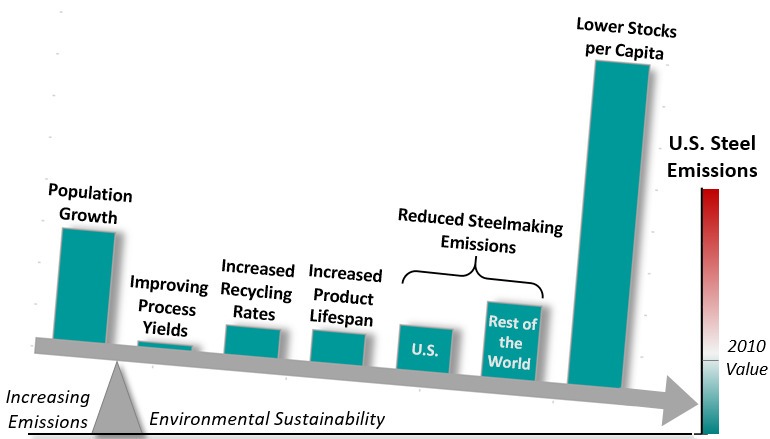
The steel sector emits 25% of global industrial greenhouse gases, and the U.S. is the world’s second-largest steel consumer. In this article, we determine how CO2 emissions attributable to U.S. steel consumption can be cut by 70% by 2050. We vary four key steel cycle parameters (U.S. steel stocks per capita, recycling rate, product lifespan, and manufacturing yield) in a dynamic material flow analysis to determine a range of values for annual steel demand and the scrap available for recycling. We combine these data with steelmaking technology and trade scenarios to calculate potential U.S. steel sector emissions in each year to 2050. Only 20% of the pathways we modeled for the U.S. steel sector achieved the emissions target. Emissions in 2050 are most sensitive to the CO2 released per kilogram of steel produced and the steel stocks per capita. Deployment of emerging low carbon steelmaking technology alone is insufficient to achieve the emissions cut; conversely, reducing stocks per capita from the current ∼11 tons/capita toward levels in the U.K. and France, ∼8 tons/capita, would enable the emissions cut to be achieved under a range of foreseeable steelmaking technology scenarios and steel cycle parameters. If action to reduce per capita steel stocks is delayed by more than five years, then it is likely infeasible for the U.S. steel sector to stay within its 2050 CO2 budget because of the increased demand for emissions-intensive steel made from iron ore.
Please view this website on a desktop for full content.


