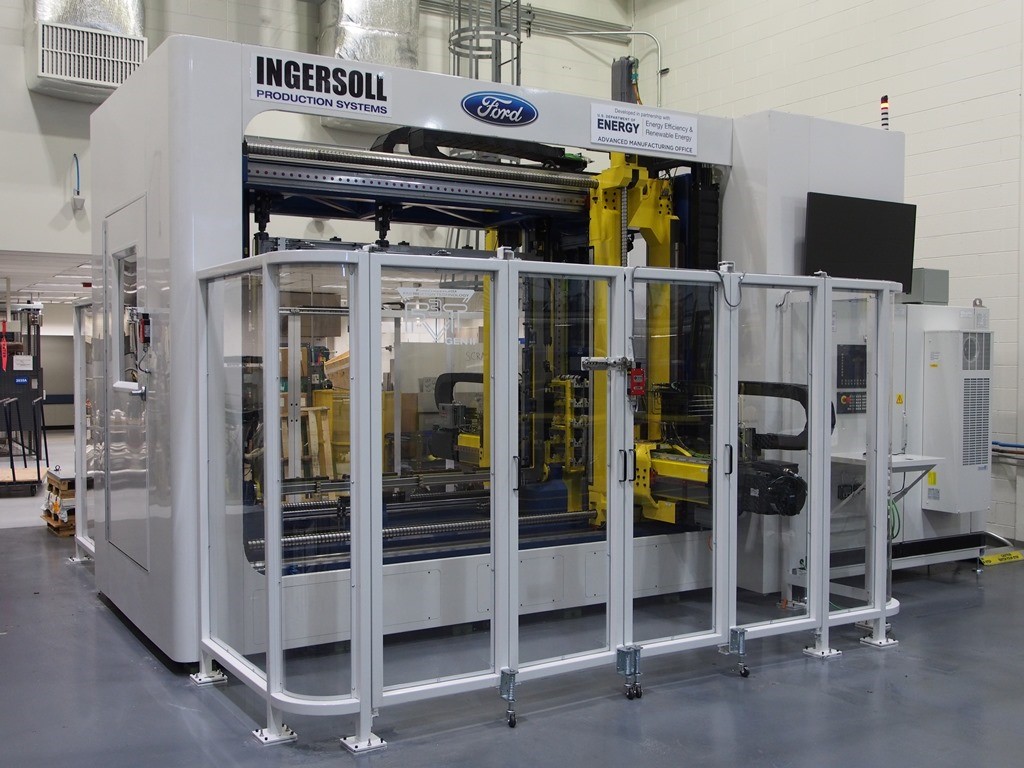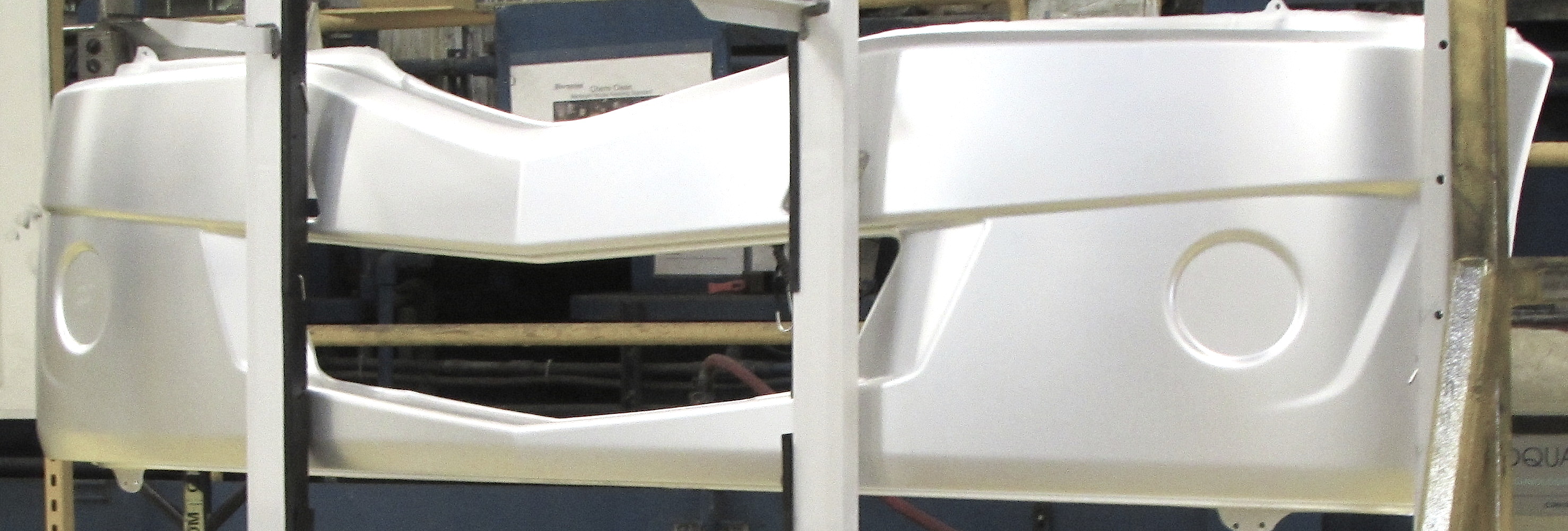
Industrial emissions must be dramatically reduced to avoid the potentially dangerous effects of climate change. In order to contribute to the necessary cuts, this article focuses on the energy and material efficiency of sheet metal forming. The processes considered include traditional methods, such as drawing and stretch forming, and newer technologies developed in recent decades such as hydroforming (fluid cell forming), superplastic forming, and incremental sheet forming.
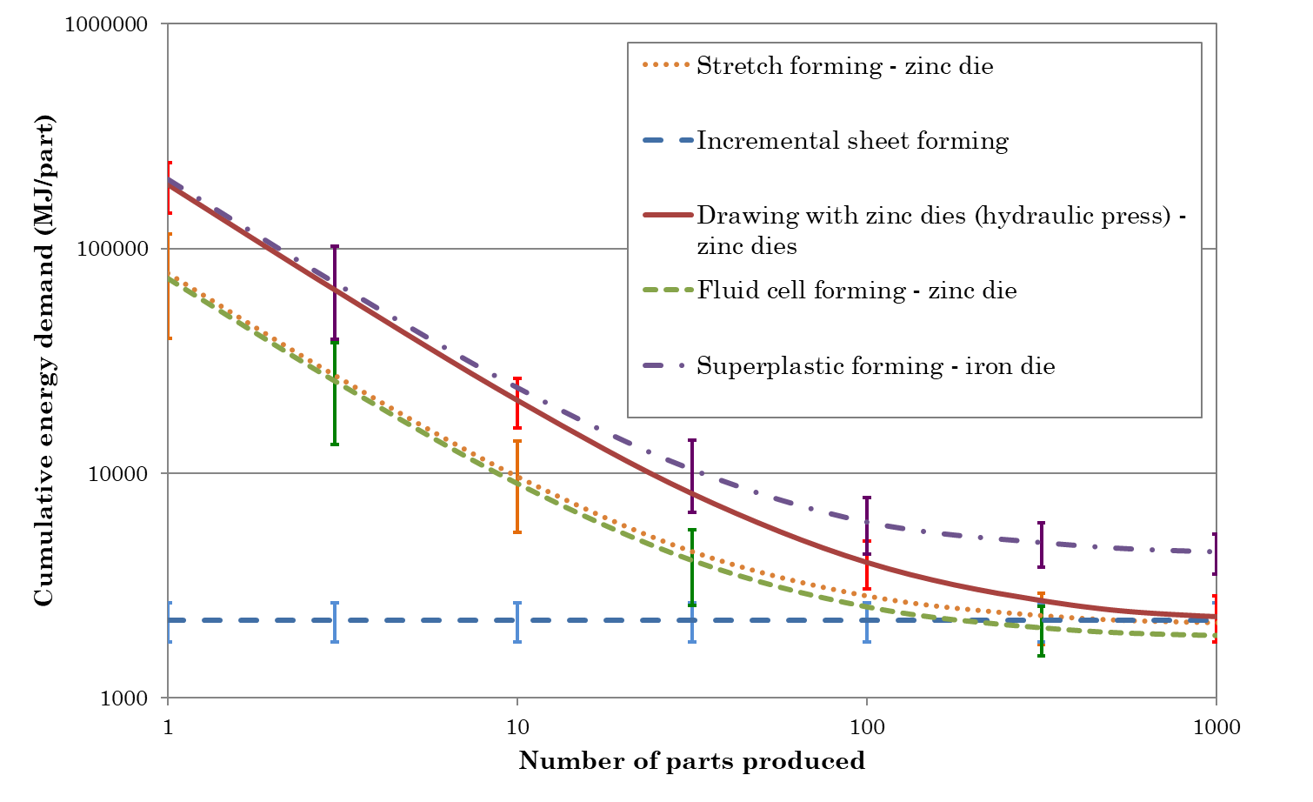
In this analysis, we conduct case studies on forming processes at leading US car and aerospace manufacturers. The case studies include electrical power measurements on the forming machines and also consider the impacts of making the dies, sheet metal, and lubricant. Cradle-to-gate energy demands and environmental impacts are modeled in SimaPro using data based on ecoinvent 3.1 database values. The results show that idling consumes significant electricity; however, other than for incremental forming, the impacts of press electricity are small compared to the impacts of making the sheet metal. The case studies inform generalized models for each process that allow per part impacts to be estimated based only on final part material, size (surface area, thickness, and depth), and the number of parts produced over the die-set lifespan. The models are used to investigate the potential to reduce cradle-to-gate energy requirements by using incremental forming instead of drawing to form parts. It is found that there are significant potential savings for small production runs, consistent with part development/prototyping. However, these savings vary depending on the part size and the relative buy-to-fly ratio (material yield) of the two processes.
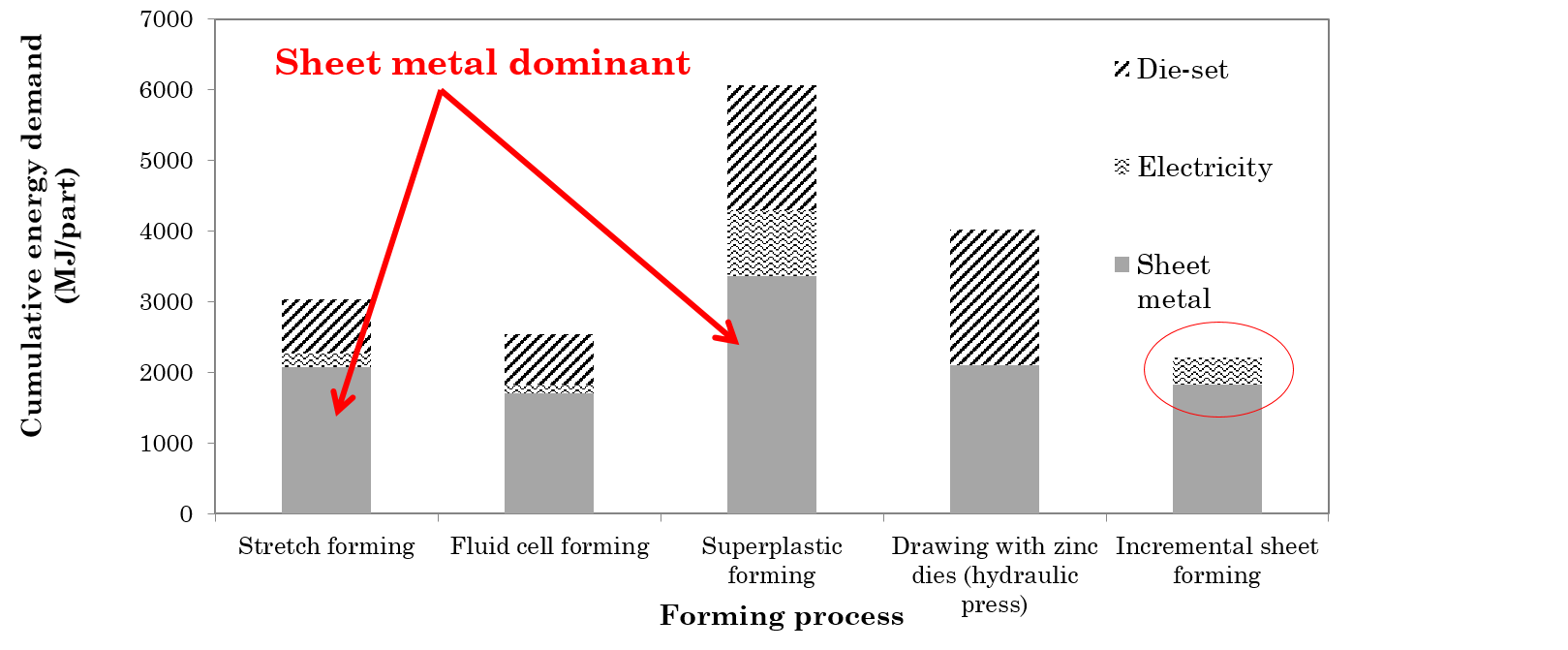
The results of this study highlight that for small production numbers over the die lifespan the impacts of die-making are important. However, as production numbers increase above one hundred parts per die-set, the impacts of making the sheet metal become dominant. It is therefore concluded that researchers interested in reducing the environmental impacts of sheet metal forming concentrate on innovations that would reduce sheet metal blanking and post-forming trimming losses

Little work has been done on quantifying the environmental impacts and costs of sheet metal stamping. In this work we present models that can be used to predict the energy requirements, global warming potential, human health impacts, and costs of making drawn parts using zinc (kirksite) die-sets and hydraulic or mechanical presses. The methodology presented can also be used to produce models of stamping using other die materials, such as iron, for which casting data already exists.
An unprecedented study on the environmental impacts and costs of zinc die-set production was conducted at a leading Michigan die-maker. This analysis was used in conjunction with electrical energy measurements on forming presses to complete cradle-to-gate impact and cost analyses on producing small batch size hood and tailgate parts. These case studies were used to inform a generalized model that allows engineers to predict the impacts and costs of forming based on as little information as the final part material, surface area, thickness and batch size (number of units produced).
The case studies show that press electricity is an insignificant contributor to the overall impacts and costs. The generalized models highlight that while costs for small batch production are dominated by the die-set, the environmental impacts are often dominated by the sheet metal. These findings explain the motivation behind research into die-less forming processes such as incremental sheet forming, and emphasize the need to minimize sheet metal scrap generation in order to reduce environmental impacts.
Prospective environmental assessment of emerging technology is necessary in order to inform designers of beneficial changes early in a technology's development, and policy makers looking to fund projects and nudge manufacturers toward the most sustainable application of a technology. Existing analyses often have shortcomings such as failing to consider the environmental impacts in all stages of a product's life cycle; implicitly assuming that the emerging technology will be cost-effective wherever it is technically viable; and assuming optimistic application scenarios that discontinue long-established trends in human behavior. In this article, we propose a new approach, complementary to the prospective and anticipatory life cycle assessment literature, addressing the above concerns and attempting to make sense of the large uncertainties inherent in such analyses by using distributions to model all the inputs. The paper focuses on emerging manufacturing technologies, such as incremental sheet forming (ISF), but the issues examined are also applicable to new end-use products, such as autonomous vehicles. This paper makes use of approaches (such as Bass modeling and product cannibalization considerations) familiar to those in the business community who anticipate market diffusion of a new technology and the effect on existing technology sales. The proposed methodology is demonstrated by estimating the potential environmental impacts in the U.S. car industry by 2030 of an emerging double-sided ISF process. Energy and cost models of ISF and drawing are used to estimate potential mean savings of around 100 TJprimary and 60 million U.S. dollars per year by 2030.
Please view this website on a desktop for full content.