
Reusing steel and aluminum components would reduce the need for new production, possibly creating significant savings in carbon emissions. Currently, there is no clearly defined set of strategies or barriers to enable assessment of appropriate component reuse; neither is it possible to predict future levels of reuse. This work presents a global assessment of the potential for reusing steel and aluminum components. A combination of top-down and bottom-up analyses is used to allocate the final destinations of current global steel and aluminum production to product types. A substantial catalogue has been compiled for these products characterizing key features of steel and aluminum components including design specifications, requirements in use, and current reuse patterns. To estimate the fraction of end-of-life metal components that could be reused for each product, the catalogue formed the basis of a set of semistructured interviews with industrial experts. The results suggest that approximately 30% of steel and aluminum used in current products could be reused. Barriers against reuse are examined, prompting recommendations for redesign that would facilitate future reuse.
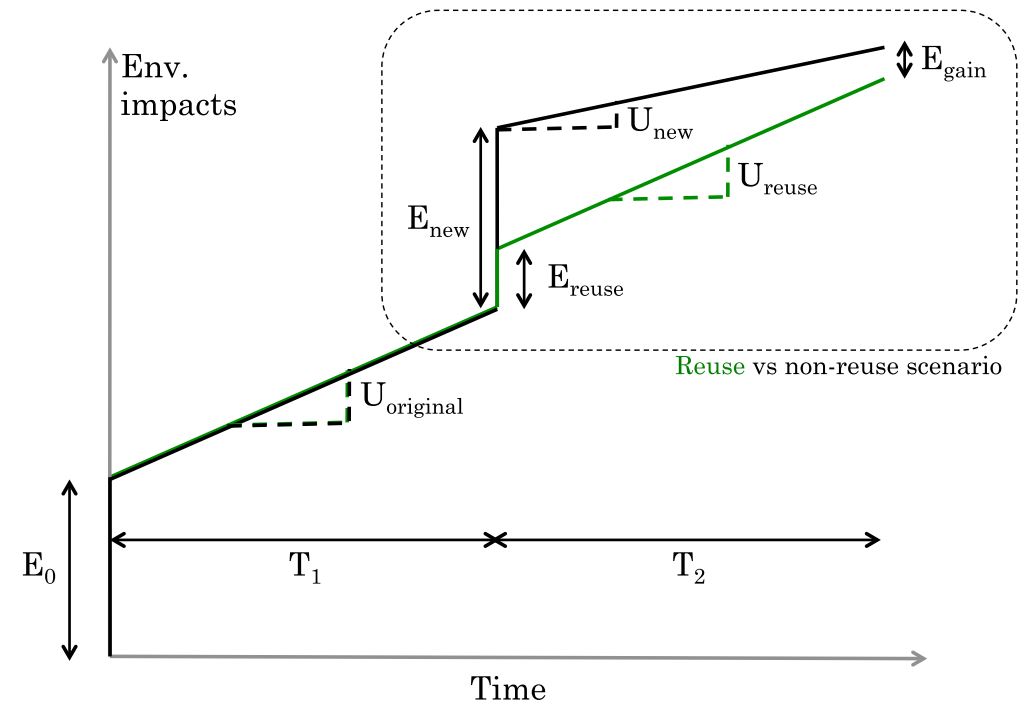
The fear that human consumption is causing climate change, biodiversity loss, and mineral scarcity has recently prompted interest in reuse because of the intuitive belief that it reduces new production and waste. The environmental impacts of reuse have, however, received little attention—the benefits typically assumed rather than understood—and consequently the overall effects remain unclear. In this article, we structure the current work on the topic, reviewing the potential benefits and pitfalls described in the literature and providing a framework for future research.
Many products’ use-phase energy requirements are decreasing. The relative importance of the embodied impacts from initial production is therefore growing and the prominence of reuse as an abatement strategy is likely to increase in the future. Many examples are found in the literature of beneficial reuse of standardized, unpowered products and components, and repairing an item is always found to be less energy intensive than new production. However, reusing a product does not guarantee an environmental benefit. Attention must be paid to restoring and upgrading old product efficiencies, minimizing overspecification in the new application, and considering whether more efficient, new products exist that would be more suitable. Cheap, reused goods can allow many consumers access to products they would otherwise have been unable to afford. Though socially valuable, these sales, which may help minimize landfill in the short term, can represent additional consumption rather than a net environmental benefit compared to the status quo.
Please view this website on a desktop for full content.
